
BOOKs
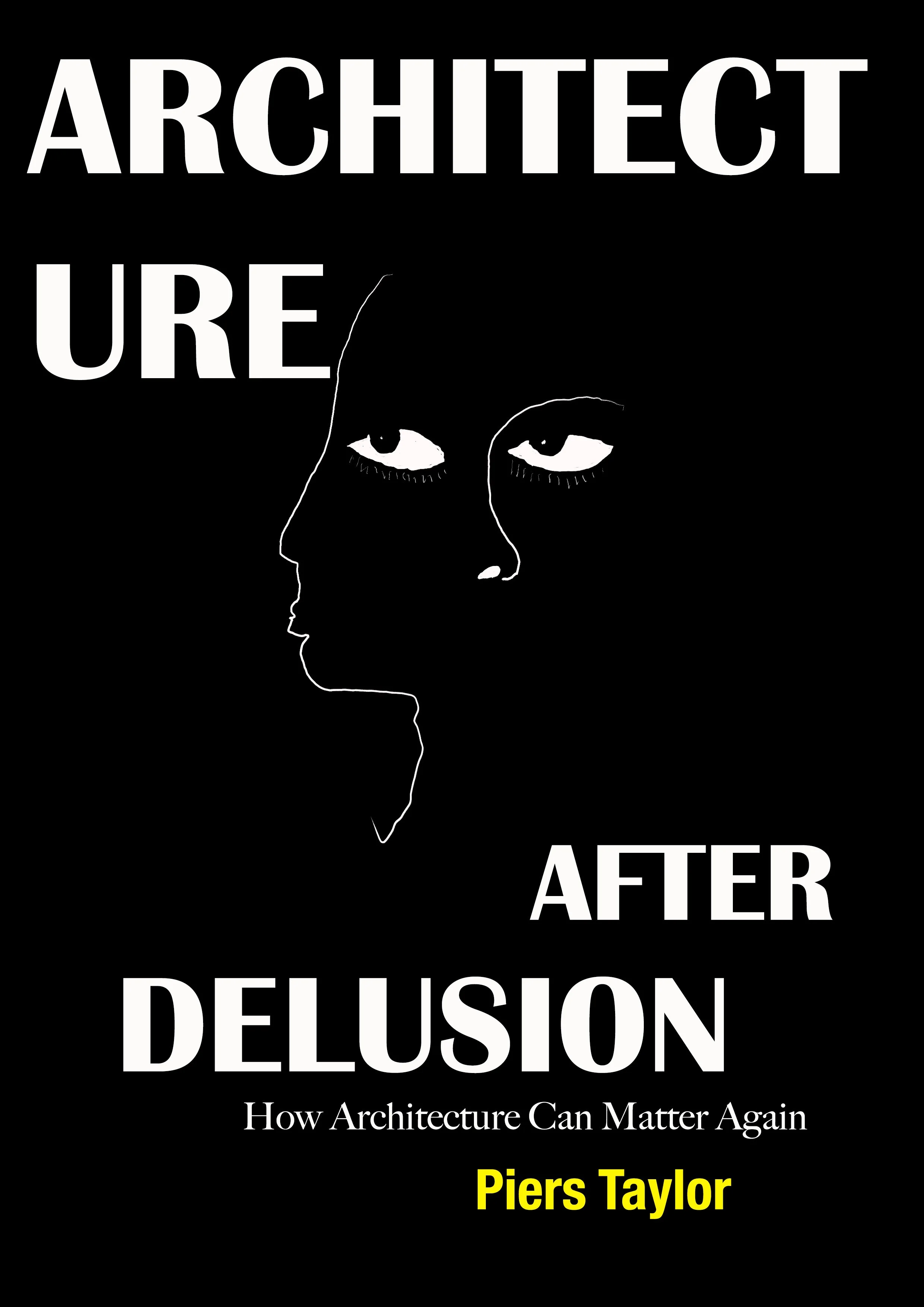
Architecture After Delusion
Architecture After Delusion is a forthcoming book by Piers Taylor to be published by Routledge in early 2027. The book is an argument with architecture from inside the discipline. It begins with a simple suspicion: architects have exaggerated both their own agency and the capacity of buildings to change the world. Architectural culture still depends heavily on the figure of the architect as singular author, visionary and cultural protagonist, and on the building as the principal object through which that agency is expressed. These ideas persist despite almost everything we know about how buildings actually come into being. Buildings depend on clients, money, planning, politics, regulation, labour, materials, contractors, maintenance, occupation and time. They are collective, compromised and continually altered. The book argues that architecture’s value does not disappear when this dependence is acknowledged. It becomes easier to understand where its value really lies.
The first part of the book takes apart some of the stories architecture tells about itself. It looks at the invention of the heroic architect, the fiction of disciplinary autonomy, the economic and institutional systems that keep those ideas alive, and the profession’s attachment to the individual building as its preferred unit of significance. It also examines architecture’s culture of representation, where images, awards, project descriptions and social media allow comparatively ordinary acts of design to acquire enormous ethical and cultural claims. Buildings are routinely described as transformative, regenerative, democratic, healing or socially radical when what they actually do may be far more limited. The problem is not ambition, nor is it beauty or formal invention. It is the inflation of the claim.
The middle of the book turns towards the things these myths tend to conceal. Buildings do not stop at practical completion. They are occupied, adapted, repaired, neglected and remade. Cities and settlements cannot be understood as enlarged architectural objects because they are always unfinished and multi-authored. Construction itself depends on forms of intelligence that the profession has historically pushed below the architect: builders, makers, engineers, maintenance workers and users. Materials also have lives beyond the sample board. They come from forests, mines, factories and supply chains, and questions of sustainability make little sense unless extraction, scarcity, land, labour and scale are included. Participation is subjected to the same test. Consultation means very little if those being consulted acquire no greater power over what happens.
The final part asks what architecture might look like once some of these habits are relinquished. The architect is recast less as author and more as host: somebody who still exercises judgement, but whose skill lies partly in establishing the conditions within which other people, materials, institutions and forms of knowledge can act. That leads to a larger argument about stewardship and infrastructure. The most consequential architectural work may lie not in producing a singular object but in increasing the capacity of a community, neighbourhood or territory to act over time.
The book finally proposes a different way of judging architecture. Alongside the familiar questions of form, material, atmosphere and spatial quality, we should ask what a building actually does. What does it enable? What does it obstruct? Can it be repaired, adapted and claimed by others? Does it support ordinary dignity, public life, local knowledge or collective action? Does it reduce burdens or simply move them elsewhere? Architecture does not need to be the sole cause of an outcome in order to matter.
The conclusion is not that architects should become less ambitious. It is that architecture should become more truthful about the scale and nature of its agency. A more modest profession would still design remarkable buildings, but would be less dependent on heroism, validation and exaggerated claims. It would understand architecture as one participant in a much larger world. That may leave architects with less glory, but potentially with a more useful, more interesting and more credible role.
“This important book brings together decades of original research and reflection on the role of architects and architecture. It is full of beautiful and provocative ideas, from the architect as host, to materials as systems, to the professional fiction of completion. We need to do architecture better, and this book shows us how.”
Professor Flora Samuel, University of Cambridge
Foreword by Jessica Prendergrast, Onion Collective CIC
I have a love-hate relationship with architecture. And with architects, for that matter.
It is a profession built on creativity, assuredness, certainty, and a healthy dose of ego. There’s no denying it’s necessary – I am astounded daily by buildings and what they make possible. But as anyone who has ever actually built one knows, the compelling concept drawings and the shiny opening-day photographs are only a part, and not even an important part, of what architecture actually is. When the architects collect their awards, puff out their chests, and move on to the next shiny project, what they leave behind carries social consequences, emotional traces, and financial impacts for years to come.
Piers Taylor argues pretty compellingly that this is the exact territory modern architectural culture habitually ignores: the mistakes, the adaptations, the fixing, the reworking, and most of all, what the building makes possible, or inadvertently makes a whole lot harder.
I say this with full self-awareness. I get sucked in by the pretty pictures, the hero charm, the creative flair, and the supreme, unflappable confidence of architects that Piers articulates in the first few, quite confronting, chapters of Architecture After Delusion. But making buildings, like making anything really, is ultimately relational: a beautiful but messy dance of interdependent systems, people, skills, constraints and dreams.
At Onion, we’ve often described the delivery of East Quay as akin to having a baby. There is the initial excitement and joy of conception. Then comes the long, painful, seemingly endless pregnancy of construction. Then the terrifying, overwhelming moment of birth – followed by the neat photo of a smiling mum and a proud dad. That picture entirely ignores the exhaustion, the blood on the floor, the tears, the stretch marks and the interfering in-laws And then come the newborn months, the tricky toddler years, and the five-year-old finding its feet, which is right where East Quay sits today. The architect takes credit for the building much like the father gets applause for conception. The mother gets a polite nod, but nobody mentions the underpaid midwives, the supportive sisterhood, the tax and benefit system (that enables or constrains parenting), let alone the people who actually made the nappies, or the complex systems of disposal needed to deal with them.
The truth is that on day one, despite the glossy photos, our building was already compromised, frustrated, and incomplete. Born out of Covid disruptions and cost overruns, material constraints caused by our coastal location, unreasonably complex funding requirements, and our main contractor going into administration right before completion, external forces played just as big a role in shaping East Quay as any grand design decision.
Architects often go to extraordinary lengths to deny this contingency. The dismissal by much of the profession of ‘almost everything that actually made the building possible, and almost everything that will determine whether it matters once the architect has left’ still very much hurts.
This is why the later chapters of this book are so powerful – especially chapter 9 on extraction, scarcity and afterlife, which rightly highlight quite how far there is to go in disentangling the profession’s complicity with extractive capitalism and its harms to the planet and to people: ‘Cheapness is often another name for distance, extraction and invisibilised labour.’ Such failing is undoubtedly a systemic one not a personal one, but as Piers insists, being part of the system does not absolve us of our responsibility to imagine otherwise, think again, try a different path, and keep striving to do better.
In the end, none of the architectural compromises or structural battles determined the difference the space actually makes today. Ours is a building made by many hands, literally and figuratively. Eleven different architects played a role across concept, technical, landscape, and interior phases. But it was imagined by hundreds of community minds, built by hundreds of labourers, engineers, groundsmen, electricians, and plasterers, and brought to life by thousands of artists, maintainers, children, chefs, and printmakers – all of them makers and remakers of the evolving building and ongoing process that is East Quay.
I definitely don’t mean that good design doesn't matter; it signals care and tells a community that they deserve exceptional things (especially important in peripheral contexts – geographically, socially, economically). The generous public spaces, the pink concrete glowing in the late afternoon light, and the first-floor walkway acting as a natural amphitheatre all exist because of architectural imagination. But the most iconic aspects of East Quay arose not from pure design sovereignty, but from happenstance, compromise, and relational adaptation. The elevated pods were never part of the original brief; they emerged as a revenue-vital hangover from an abandoned early tower concept, rightly rejected by the community. The pink concrete, now seemingly fundamental to East Quay’s identity, only happened because the original contract for grey concrete was wildly misquoted, forcing a frantic value-engineering pivot to local quarry aggregate using red Somerset sandstone. Even the V-shaped courtyard (now post-rationalised as a feminist two-fingers up) was drawn indirectly from the informal configuration of shipping containers on the quay, which had taught us just how vital sheltered open space was to hosting a community.
Conversely, where the design resisted the mess of real life, it stumbled. The tiny fraction of storage allocated to a vibrant community hub means our back road is endlessly cluttered with BBQs, timber, and random boxes – a permanent, hilarious, and slightly annoying reminder that when architects don’t fight for the reality of mess and maintenance, real life forces its way in anyway.
At Onion, we use the word practice constantly. We don't care about the outcomes that much anymore; we care about the journey. We don’t deliver things; we act in a certain way, we experiment, rehearse, fail, learn, fix, and adapt. It is never done, and it is always relational. It is about care, repair, staying with the trouble, and owning your part. As Piers highlights and East Quay demonstrates, buildings are never complete – for them the journey includes inception, construction, and aftermath: ‘The building lives because labour continues, and this should not be a marginal insight – it should be central to architectural thought’.
Our ongoing work at East Quay actively embraces this afterlife. Through our emergent retrofit programme and collaboration with architecture students at UWE, we are treating adaptation not as a problem but as an opportunity for collective learning and evolution. Five years on, as lichen makes its home on the concrete – a beautiful kind of acceptance – we are looking to re-commission the gallery M&E systems – not to create a pristine climate for high-art paintings, but to provide a cool, climate-safe sanctuary where local residents can shelter during extreme summer heatwaves. This is Julian Lewis’s process of "catching up" and "joining in" made real.
Piers is right: to treat alteration as corruption is to deny that the world is alive; to embrace it is to understand architecture as an evolving framework for collective life. It is not just about what the building makes possible, but what changing the building also makes possible, through the collective practice of remaking, reimagining, and reworking it, together.
When RIBA awarded us Client of the Year, it felt like an absurd trauma bond – seeking validation from an institutional, hierarchical culture that stood for so much of what we rejected. We had exhibited none of the qualities RIBA celebrates in a client. We had no neat brief; we had a messy, emotional, utopian one. We had nowhere near sufficient funds. We prevaricated, changed our minds, argued, interfered, put on hard hats, and physically helped finish the build – a move so contrary (women stepping in to help finish our own building, heaven forbid!) that it caused the project manager to walk off site in protest.
Piers credits us with more clarity of thought than we possessed at the time, but what we shared was a fundamental refusal to submit to how things had been done previously and a deeply held rejection of capitalist systems of value. In the decade and a half that we’ve known and worked with him, we’ve experimented, argued, learned, and grown together. The architect Piers is today is not the architect we met fifteen years ago. The critique he levels against the profession in these pages includes himself; he holds his own ongoing failings directly to account. He lays out some brutally honest home truths, not just for the industry, but for himself. It makes this book both a relentless exercise in self-reflection and a deeply powerful manifesto for professional (and personal) change.
We all like to look back with some revisionism. It’s like an abusive relationship that in the end makes you revisit who you are. Can you blame them for what they did? Of course. But isn’t the real question why you accepted it? Piers could have easily stayed in his ego and kept moving on when the completion photos were taken. That he has instead stayed in relationship and done the deep, uncomfortable work of dissecting the personal, systemic, cultural, and patriarchal biases underpinning his role is to his credit, and his profession’s betterment.
It takes a village to raise a child, and it takes a village to make a building matter. Piers does not claim to have all the answers, but he asks the hardest, most necessary questions. Ultimately, this book is not about the destruction of architecture but the possibility of its liberation – by embracing a much more real, entangled, relational and contingent role.
The work of architecture is not to build monuments to individual vanity, but to design spaces that can be occupied, altered, repaired, governed, sustained and, perhaps most important of all, loved across time by the very many hands who are touched by them and who care for them in return. That is a far more difficult ambition, but one through which architecture can, with some humility, replace its delusion not just with usefulness but with dignity, courage and grace.